I-215: Wasatch Revamp
The Interstate 215 project is a major investment in keeping traffic flowing freely and safely in Salt Lake City, UT. We sat down with Project Manager Casey Green to learn more about it.
Tell me a little about the project’s geography. Where exactly are you in Salt Lake City?
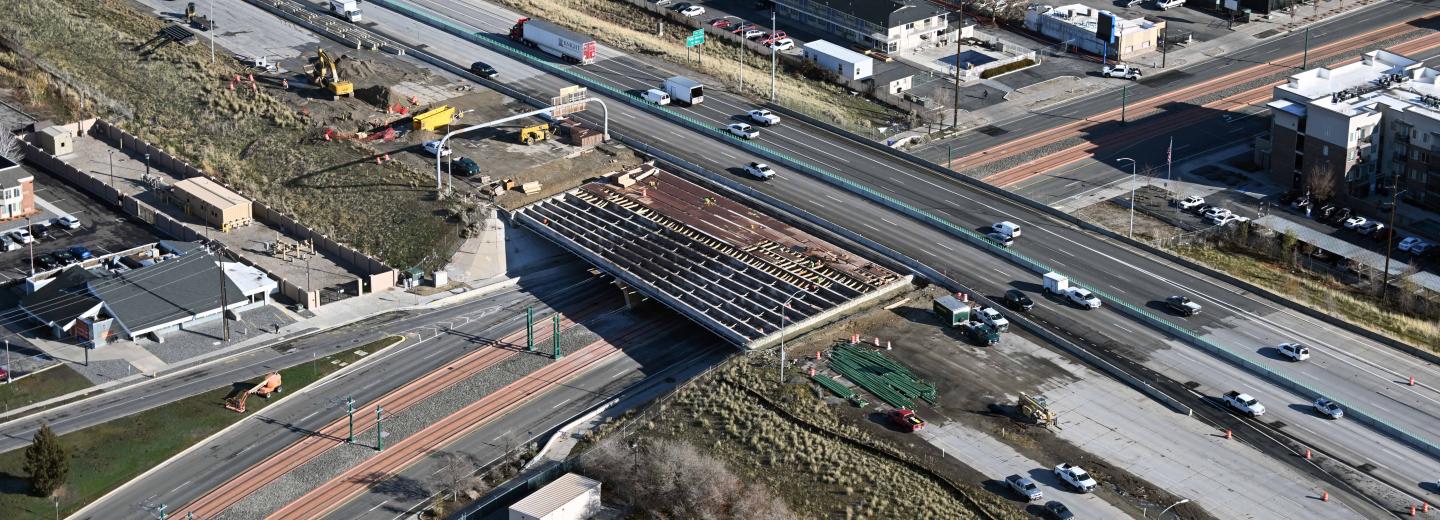
I-215 is a belt route that wraps around the Salt Lake Valley in the north-central part of the state. On the east side, it’s right up against the Wasatch Range, but we’re working on the west side, very near Salt Lake City International Airport, where I-215 and I-80 come together. It’s a congested area with layers of highways running over each other; there are four rail segments in the project area and even a canal.
What is Granite’s scope of work?
We have a 3.5-mile segment of highway, where we are basically reconstructing the entire width of the road, including all 22 bridges on the project. On 18 of those, we are doing a full-depth reconstruction: ripping the deck off, the concrete, everything, then installing new rebar and pouring new decks. And 13 of these bridges run right through the I-80 connection. There’s a lot of earthwork too—something like 23K linear feet of drainage—so it is a dense, complicated area.
What is the project’s current status, and what’s coming up?
We’re currently in phase 2. In phase 1, from July to November 2025, we did median work and all the temporary infrastructure to move traffic. On November 8, we started phase 2, diverting all traffic into the northbound lanes. Currently, we are execut ing all the work on the southbound lanes. We’ll be pouring a couple of bridge decks a week, and we aim to start mainline paving by the end of March. Then right before the Fourth of July, we’ll switch traffic to the southbound lanes and do it all again on the northbound side!
Are there any innovations on this project?
There are two big ones.
First, we are using a new mix design from the Utah Department of Transportation—the “high mod” mix. (read more below) The oil is highly modified, and it has some really impressive performance specs. It’s an expensive new process, but it should pay off with great performance.
The second innovation is that this project uses rubblization of the existing concrete, then we are going to pave right over that. We are using resonant breakers from Resonant Machines Inc. It’s a pretty cool machine: you run it over the concrete, and it’s vibrating a head at 40 times per second to break up the concrete into very consistent particles. I’ve used guillotine breakers and multihead breakers before, but this is my first experience with the resonant machine, and it’s working great.
One other thing: This is the first project to be paved out of our new Godfrey Plant, which is just a mile from the site. Godfrey replaced the old Walker Facility near Big Cottonwood Canyon, and it’s nice to break it in with such an important project.
What have been the biggest logistical challenges?
Anytime you are doing a project like this, there is a lot of focus on how to keep traffic moving. We worked with a traffic designer to come up with a plan to maintain traffic flow with very little impact.
Another challenge is dealing with access as you are ripping up the bridges. Suddenly, you’ve removed the decking and you can’t get over to the other side, so you have to be thoughtful about how you plan that out. You don’t want to paint yourself into a corner!
Finally, we’re dealing with four different railroads, each with its own rules and processes. Getting the permitting done on those rail areas so we could work around and above them was a huge task. We had an engineer on that almost full-time just to coordinate getting all the rail permits.
Highways are symbolic of our freedom to traverse this great country. Any thoughts on being part of this project?
At Granite we help people—our work connects people. I look at it like, If my family were driving here, is this how I’d want it done? Everyone on this project takes a lot of pride in doing great work and in building something that will last. We’re building America. We’re being good stewards. We work together, we get stuff done right, and we get it done fast
Designed for Extremes: Innovative Pavement Mix Design
The I-215 reconstruction project is deploying a new pavement mix design known as highly modified hot-mix asphalt (HMHMA). This mix incorporates a PG-76-34 binder, the most robust binder in Petra Oil’s PG-76 series.
Designed for extreme weather and heavy loading, the mix is rated to perform in temperatures as low as –30 degrees and as high as 169 degrees F. This makes HMHMA well suited for arctic, subarctic, and alpine climates subject to frequent freeze-thaw cycles.
The advanced polymer-modified binder enhances resistance to rutting during extreme summer heat and cracking during severe winter conditions, while also supporting heavy-duty freight and logistical routes. Its extended service life makes HMHMA ideal for strategic corridors where maintenance access is limited and long-term performance is critical.
